 Clement Brako Akomea
Table of Contents
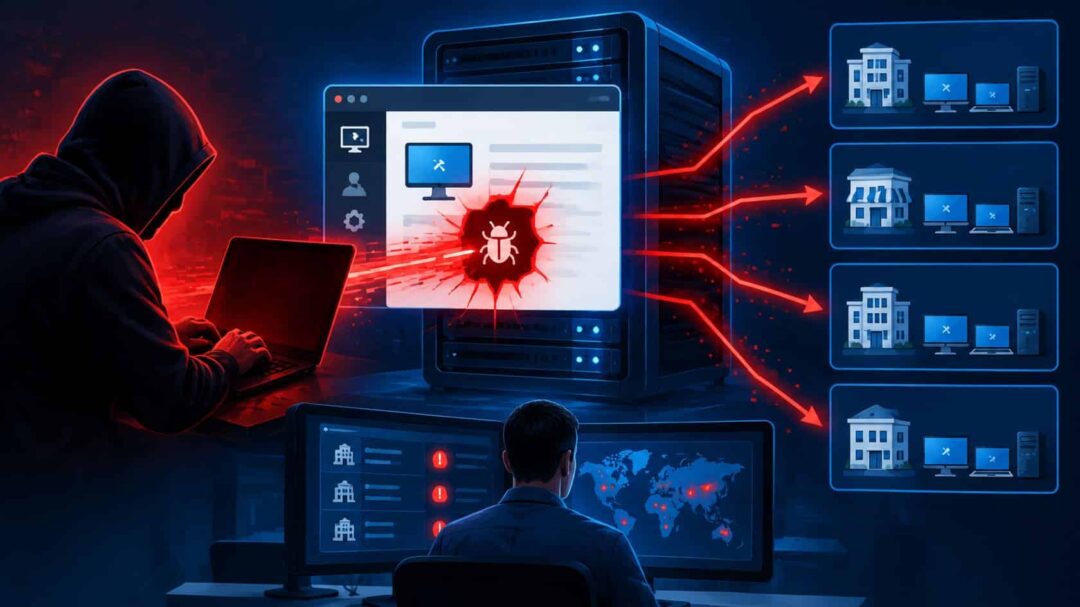
The ScreenConnect CVE-2026-84869 vulnerability is being used against managed service providers (MSPs), according to a Huntress report. The flaw lets a guest in a ScreenConnect session push a file to the technician’s own computer and run it without a prompt.
Huntress observed activity from October 20 to November 16, 2026. It counted at least 688,000 guest “run file” requests from 29 IP addresses against 42 MSP servers. In one case, a technician workstation was fully compromised in about nine seconds.
MSPs, IT service desks and any team that runs self-hosted ScreenConnect should pay attention. A compromised technician machine often holds credentials and remote access to many customer networks.
ScreenConnect CVE-2026-84869: Key Takeaway
- Updating only the ScreenConnect server does not fix this flaw; every technician host client must be updated to version 26.6.5 or later.
This section contains affiliate links; we may earn a commission at no cost to you.
Protect the credentials on technician machines. 1Password is a password manager that helps teams keep unique logins and rotate them quickly after a suspected compromise.
Get help when a workstation is compromised. CrowdStrike provides AI-native cybersecurity software and incident response services.
What Happened: A Guest Session Turns Into Code Execution on the Technician’s PC
ScreenConnect is a remote support and access tool. In a normal session, a technician connects to a guest, which is the person being helped. CVE-2026-84869 reverses that trust. According to Huntress, which quotes the vendor’s description, a guest can make the technician’s host client run a file without a prompt, including with elevated rights. This applies to both Support and Access sessions.
The CVSS score is 9.9, as reported by The Hacker News. The CVSS vector was not available from the sources read for this article.
Timeline
- September 8, 2026: ConnectWise disclosed the flaw, according to Huntress. The ConnectWise bulletin could not be opened for this article, so its contents are not independently confirmed here.
- September 11, 2026: Huntress says CISA added the flaw to its Known Exploited Vulnerabilities catalog. The catalog page could not be read, so this is attributed to Huntress only.
- October 19: a push of a file named Run-Lateral.bat was attempted but not delivered.
- October 23, 24 and 27: a path traversal push of Sync.bat into a Windows Startup folder was tried against three real support sessions.
- November 12: one MSP technician workstation was fully compromised in about nine seconds. A script reported to a Telegram bot, downloaded WindowsUpdate.msi from masterdarky[.]com, and started a rogue ScreenConnect client.
- November 13: a harmless marker file was pushed to a second technician, which Huntress describes as a canary.
- November 16: Huntress published its analysis.
Who Is Behind It
Huntress says the operator of the spray activity and the operator of the masterdarky[.]com infrastructure are very likely the same, with high confidence. No named threat group is given in the sources.
How the Attack Works
- The attacker joins a ScreenConnect session as a guest.
- The attacker pushes a batch file, such as update.bat or a file named update_ followed by eight hexadecimal characters, to the technician’s client.
- The client runs the file without asking the technician.
- The script contacts attacker infrastructure and installs a rogue ScreenConnect client that connects back to masterdarky[.]com on port 8041.
Huntress also describes two separate campaigns that are easy to confuse with this one. A worm called SCKit does not directly exploit CVE-2026-84869. A separate campaign created fake crypto exchange themed guest sessions on at least 118 self-hosted servers, which Huntress describes as a leading hypothesis for bait tied to this flaw. Huntress reports no malicious activity from those sessions. Its post gives two session counts, 2,408 and 2,223, so treat the figure as approximate.
Who Is Affected
Organizations that run ScreenConnect with technician host clients are in scope. The exact range of vulnerable versions was not stated in the sources read. Huntress notes that old clients, including 22.x, 24.2 and 25.8, are still in use. The fixed version is 26.6.5 or later for technician host clients and affected Access agents.
MSPs carry the highest risk because one technician workstation can reach many customers.
Steps Administrators Can Take
- Update every technician host client to 26.6.5 or later. Updating only the server is not enough, per Huntress.
- If you cannot update yet, remove the TransferFiles permission from roles and session groups, which is the interim advice from ConnectWise as quoted by Huntress and The Hacker News.
- Hunt on the server in App_Data\Session.db for RanFiles events (85) and SentFiles events (86).
- Hunt on workstations for the client spawning scripts from Documents temp folders, new Startup entries such as Sync.bat, folders named wclient_ followed by eight hex characters, and temp files named wupdate_ followed by eight hex characters.
- Isolate any workstation with a hit, remove the rogue client and rotate every credential reachable from it.
- Block or investigate traffic to masterdarky[.]com.
- Restrict guest permissions and do not join unattended sessions you cannot tie to a customer.
Implications
Technician Machines Are High Value Targets
Attackers no longer need to break into each customer. One technician endpoint can offer remote access to many networks. Treat these machines like privileged servers.
Patching a Server Is Not Patching the Fleet
This flaw sits in the host client. Many teams track server versions but not the clients on technician laptops. Old clients still in use leave a gap that server updates do not close.
Speed Leaves Little Time to React
Huntress describes a compromise in about nine seconds. Detection that depends on a person reading an alert will often be too slow. Automated isolation of the endpoint matters more here. See our guide to what cyber incident response involves for planning.
Remote Access Tools Need Zero Trust Thinking
Remote support tools hold deep trust by design. Limiting who can start sessions, what a guest may do and where technician machines can reach follows the same logic as zero trust architecture.
This section contains affiliate links; we may earn a commission at no cost to you.
See what is on your network. Auvik offers network monitoring and management, which helps you spot unexpected devices and connections.
Keep your security program organized. CyberUpgrade provides cybersecurity compliance and management.
Looking Forward
Huntress links the activity to a single operator with high confidence, but no group has been named. Whether the fake crypto sessions on more than 100 servers are preparation for later attacks remains a hypothesis.
Several details are still unconfirmed in the public sources read here: the full list of vulnerable versions, the CVSS vector, the official dates in the ConnectWise bulletin and the CISA listing. Administrators should check the vendor bulletin directly.
Questions Worth Answering
What is ScreenConnect CVE-2026-84869?
- It is a critical flaw, scored 9.9, that lets a guest in a ScreenConnect session run a file on the technician’s host client without a prompt.
Is ScreenConnect CVE-2026-84869 being exploited?
- Yes. Huntress observed at least 688,000 guest run file requests from 29 IPs against 42 MSP servers between October 20 and November 16, 2026.
Which version fixes the flaw?
- Version 26.6.5 or later fixes technician host clients and affected Access agents, according to Huntress.
Does updating the ScreenConnect server fix it?
- No. Huntress says updating only the server does not fix the issue, so the technician clients must be updated.
What is the workaround if I cannot update?
- Remove the TransferFiles permission from roles and session groups, as advised by ConnectWise and quoted by Huntress.
Who is behind the attacks?
- No named group is given. Huntress says the operators of the spray and the masterdarky[.]com infrastructure are very likely the same.
How fast can a compromise happen?
- Huntress describes one technician workstation being fully compromised in about nine seconds on November 12.
Is the SCKit worm the same as this flaw?
- No. Huntress says the SCKit worm does not directly exploit CVE-2026-84869 and is a separate campaign.
How do I check if I was hit?
- Look for RanFiles and SentFiles events in the server session database, scripts spawned by the client, new Startup entries and connections to masterdarky[.]com.
Is the flaw in the CISA catalog?
- Huntress says CISA added it on September 11, 2026. The catalog page could not be read for this article, so confirm it on CISA’s site.
This section contains affiliate links; we may earn a commission at no cost to you.
More tools worth a look: 1Password for logins, Optery for personal data removal and EasyDMARC for spoofed email.